

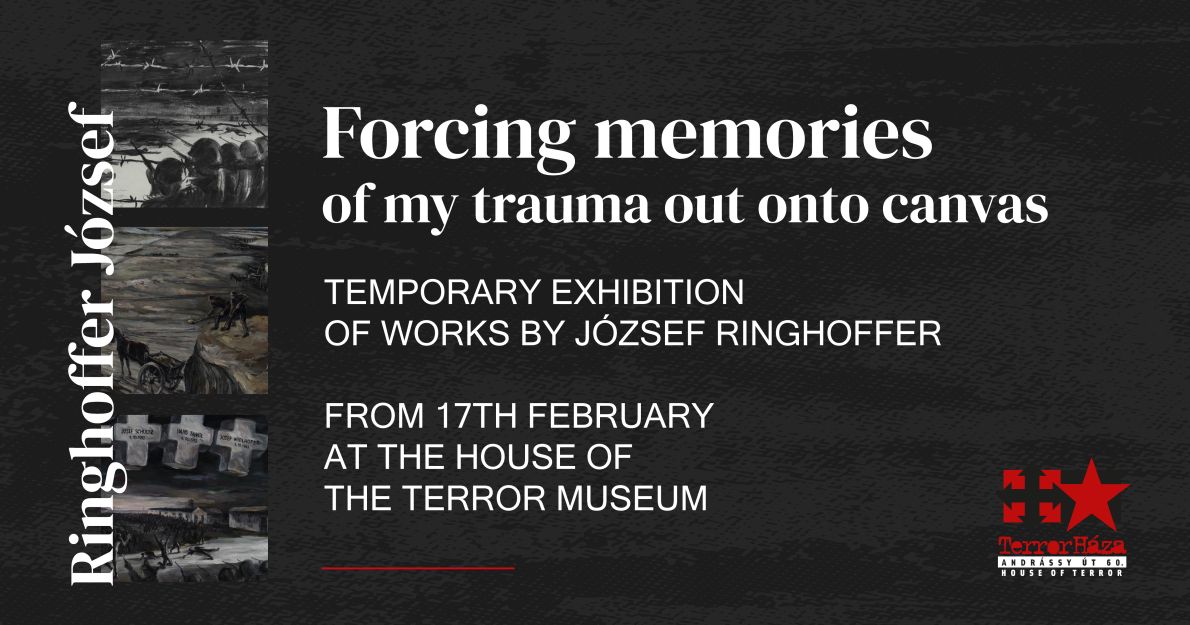
On the Day of Remembrance for the Victims of Communism, the House of Terror Museum is exhibiting a selection of József Ringhoffer's paintings and graphics depicting the prison uprising in Tiszalök.
He was 23 years old when he was deported to the forced labour camp in Tiszalök, to work under inhumane conditions on the construction of the Tiszalök river barrage. On 4 October 1953 he and his fellow prisoners rebelled against the camp leadership, in response to which the State Protection Authority (ÁVH) guards opened fire, killing five and seriously injuring several others. He was released in the autumn of 1953, later leaving Hungary for Stuttgart in West Germany, where he started a new life.
An important part of József Ringhoffer's oeuvre consists of paintings and drawings depicting the events of the 1953 Tiszalök uprising. These were donated by the artist to the House of Terror Museum. Looking back on the creation of his works, he said the following: "When I was finally released from captivity, I wanted to forget the horrors. I thought I could banish those memories. Captivity took a physical toll on me, but the mental burden was much heavier. I would wake up in the middle of the night , having dreamt of being interrogated . The images of the horrors of 4 October were constantly visible to me. My doctor advised me to paint, in order to release these oppressive memories."
On the Day of Remembrance for the Victims of Communism, the House of Terror Museum is exhibiting a selection of József Ringhoffer's paintings and graphics depicting the prison uprising in Tiszalök.